A property browser for investors
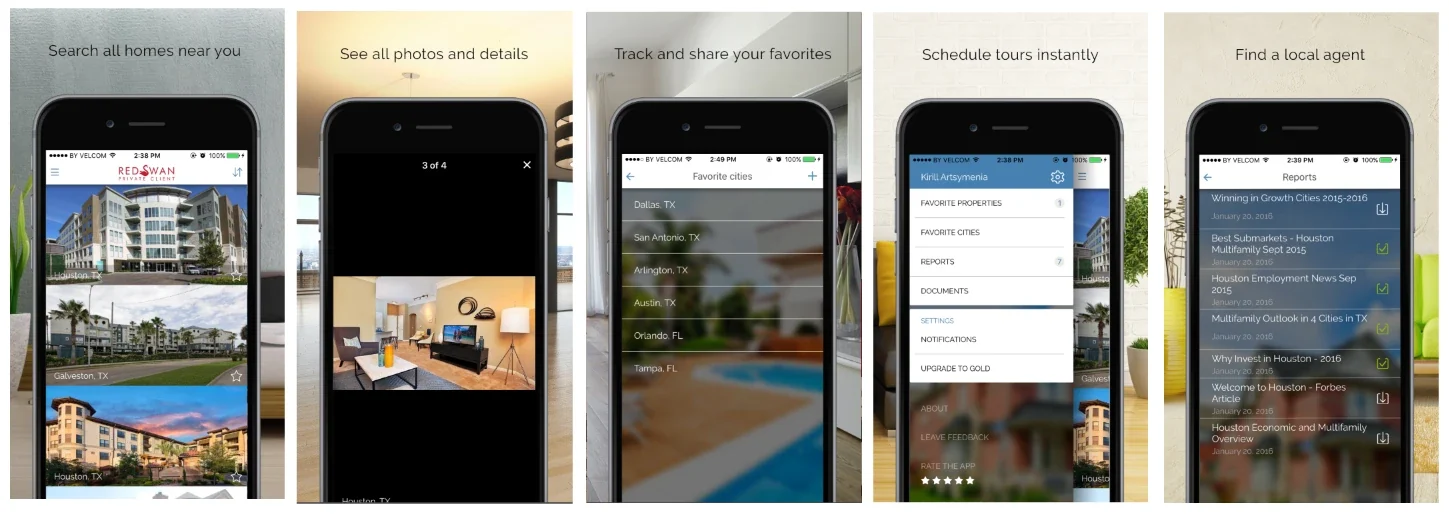
Search by location, photo galleries and property details, favourite properties and cities, tour scheduling, and a library of market reports, in an app distributed privately outside the public App Store.
2015–2023 · USA · iOS + web · Public. One client, two builds three years apart: a private property app, then the platform behind a tokenized real estate marketplace.
RedSwan is a digital marketplace for commercial real estate. In its founder's words, it tokenizes real estate debt and equity into digital securities, so investors can buy at smaller price points and sell without waiting out a long hold.
That founder, Edward Nwokedi, came to Kirill twice. The first time he needed an app. Three years later he needed a platform.
In 2015 the team shipped RedSwan Private Client, an iOS app with one job: put real estate in front of investors.
It was distributed privately, outside the public App Store. RedSwan took it and used it. Then, in 2018, Edward came back with a bigger request.
In 2018 RedSwan's founder asked for a platform: first a website, then one built specifically for tokenization.
Kirill designed it from zero, end to end: the investor cabinet, the property listing, and every flow between them. He thought the whole platform through himself, then ran the build.
The team was four people on RedSwan's side and four on Kirill's. The code was written by two developers Kirill hired and directed. His own role was technical product manager, not developer.
Two surfaces, three years apart.
Search by location, photo galleries and property details, favourite properties and cities, tour scheduling, and a library of market reports, in an app distributed privately outside the public App Store.
A property list and a report list, a photo gallery for every property, and an investment panel that shows the minimum allocation and how much interest is already expressed. The investor picks a number of increments and registers interest, and the address stays gated until they ask for it.
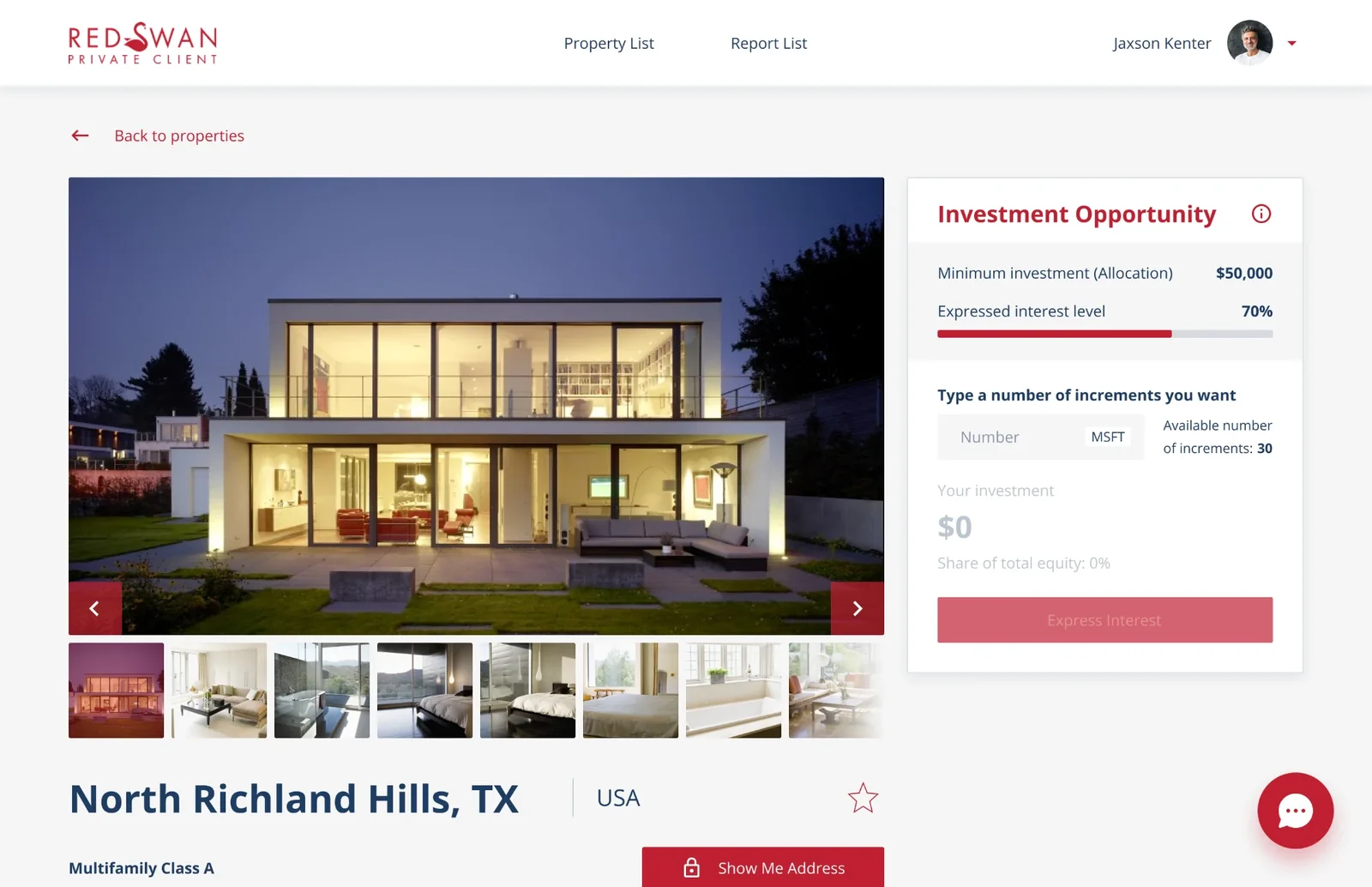
Payments were not integrated at that stage. The plan was to test everything first, and money moving through the platform could wait until the flows were proven.
A secondary market was not needed either.
A working platform. Investors could browse offerings and reports and register interest through it, and RedSwan continues to run its marketplace for tokenized commercial real estate at redswan.io.
The collaboration wound down around 2023, when the changes stopped coming.
| Claim | Evidence |
|---|---|
| The client came back | An app in 2015, a platform request in 2018, and work continuing until around 2023 |
| The product shipped | A working platform that RedSwan used with its investors |
| One owner can hold a whole product | The full platform was designed by a single technical product manager and delivered by a four-person team |
| The relationship held | RedSwan's founder describes it in a public video testimonial |
Not a fixed scope.
The platform was contracted on a fixed scope, and for a product that was still being discovered that was the wrong shape. Every change became a negotiation, and a good part of the effort went into overhead around the work instead of the work.
Time and material would have fit better. When the questions are still being found while the thing is built, pay for the time, not for a scope that will be reopened.
RedSwan continues to operate its marketplace for tokenized commercial real estate. The collaboration wound down around 2023, and its founder still considers Kirill for technology projects, as he says in the testimonial.
Public sources, for anyone who wants to check rather than take it from us:
He was the technical product manager. He designed the investor platform from zero, end to end, and led the build. Two developers he hired and directed wrote the code; he did not write it himself.
RedSwan Private Client, an iOS app distributed privately outside the public App Store. It let investors search properties near them, see photos and details, keep favourite properties and cities, schedule tours, read market reports and find a local agent.
Not at that stage. The plan was to test the flows first, and a secondary market was not needed either. This case does not claim payments or custody expertise.
Because the product was still being discovered while it was built. Under a fixed scope every change became a negotiation and much of the effort went into overhead. Time and material fits work where the requirements are still moving.
The iOS app shipped in 2015, the platform request came in 2018, and the work wound down around 2023, once changes stopped coming.
If you would rather talk it through before sending a brief, book a short routing call and we will point you to the right next step.